
Deep Sleep and Alzheimer's: What Two New Studies Can and Can't Say
Topics: Brain & Mind
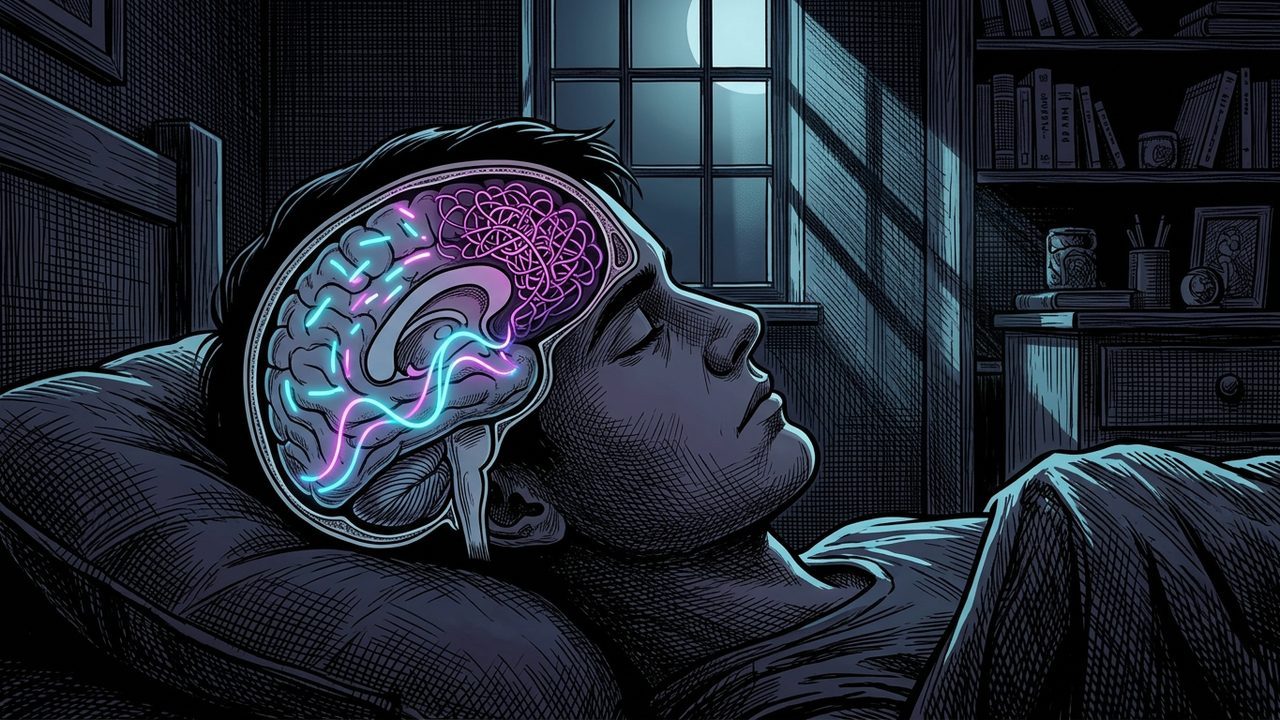
Two findings about deep sleep and Alzheimer’s disease traveled widely this fall. In September, a team at UC Berkeley reported in Nature Neuroscience that as the protein tau builds up in the frontal cortex, the slow brain waves of deep sleep lose their ability to sweep across the brain, and overnight memory suffers. Around the same time, a Yale analysis linking less deep sleep and less REM sleep to a smaller Alzheimer’s vulnerable brain region, 13 to 17 years later, circulated again as fresh news. It was in fact published in the Journal of Clinical Sleep Medicine in 2025.
Read together, they make a coherent and genuinely interesting picture. Read as headlines, they get turned into something neither study claims: that a short night of deep sleep causes Alzheimer’s.
The Berkeley study: lonely waves
Deep sleep, or non REM slow wave sleep, is defined by large, slow electrical waves. Each one, in the words of lead author Omer Sharon, a postdoctoral researcher at Berkeley’s Center for Human Sleep Science, “reflects an enormous population of neurons switching off and back on together.” In a healthy brain, these waves start in the frontal cortex and travel backward across the scalp.
The team recorded sleep EEG in cognitively healthy adults in their early 20s and in older adults in their mid 60s to mid 70s. In the young, clusters of slow waves traveled roughly a handspan across the scalp. In the older group, the waves were shorter and more isolated, what the authors call “lonely” waves. Tau PET scans, run with Berkeley neuroscientist William Jagust, showed that more tau in the frontal cortex went with more of this breakdown. Participants learned word pairs in the evening and were tested the next morning; those with more lonely waves remembered less.
Two features make the paper stronger than a typical association study. A subset of participants returned years later, and those whose frontal tau had risen also showed worse slow wave coordination and weaker overnight memory. And the pattern was replicated in a separate clinical cohort at Washington University in St. Louis, led by neurologist Yo-El Ju, using spinal fluid instead of PET: people with more solitary slow waves had higher ratios of tau to amyloid.
None of the participants had Alzheimer’s. “They had tau in their brains, but with subclinical impacts,” Sharon said. “Their memory decline was within the normal range for their age.” The abstract’s own conclusion is careful: tau’s effect on memory appears to be “not wholly direct” but partly routed through these disrupted waves.
The Yale study: a smaller region, a decade later
The Yale team, led by postdoctoral associate Gawon Cho in the lab of geriatric sleep physician Brienne Miner, used the Atherosclerosis Risk in Communities study, a long running NIH funded cohort. Its 270 participants had one night of polysomnography at a median age of 61 and a brain MRI 13 to 17 years later. Median time in slow wave sleep was 17.4% of the night, and in REM sleep 21.5%.
After adjusting for covariates, each percentage point less of slow wave sleep went with an inferior parietal region about 44 cubic millimeters smaller, and each point less of REM with one about 76 cubic millimeters smaller. The inferior parietal region integrates sensory and spatial information and is affected early in Alzheimer’s. After correction for multiple comparisons, both links held for that region. Arousals during the night were not associated with any region, and no sleep measure was linked to cerebral microbleeds.
The authors conclude that sleep architecture “may be a modifiable risk factor” for Alzheimer’s. The word doing the work there is “may.”
What the studies cannot tell you
Both are observational, so the arrow can run either way. Tau is known to disturb neural circuits, and the Berkeley authors frame their result as tau degrading slow waves, not poor sleep producing tau. Sharon is explicit: “We can see tau and lonely waves rising together over time. What we cannot yet say is which leads.” Earlier work points both ways at once, including a 2019 Washington University study in Science Translational Medicine that tied reduced non REM slow wave activity to tau in early Alzheimer’s disease.
The Yale result has its own limits. Sleep was measured on a single night, years before the scan. Every participant was White, and the cohort was relatively educated, with 47% holding 16 or more years of schooling. Brain volume is an imaging outcome, not a diagnosis; the study did not count who went on to develop dementia. And a volume difference per percentage point of sleep is a statistical slope across a group, not a forecast for any one person.
There is also a measurement gap that matters for anyone tempted to check their own numbers. Both studies relied on clinical grade EEG. The Berkeley signal is not even the amount of deep sleep but how the waves travel across the scalp, something no consumer ring or watch records. Wrist devices pick up genuine body rhythms, as in a recent study of 809 adults, but they estimate sleep stages indirectly, and deep sleep is the stage they tend to get wrong.
What the studies show / what they don't
- Shows: in healthy older adults, more frontal tau goes with fragmented, nontraveling slow waves and weaker overnight memory, and the pattern held over time and in a second cohort measured with spinal fluid.
- Shows: in 270 middle aged adults, less slow wave and REM sleep on one night went with a smaller inferior parietal region on MRI 13 to 17 years later.
- Doesn't show: that losing deep sleep causes Alzheimer’s, that improving deep sleep prevents it, or that a consumer tracker can measure the signals these studies used.
- Status: two peer reviewed observational studies (Nature Neuroscience, 2026; Journal of Clinical Sleep Medicine, 2025) plus university press releases. The Yale paper is not new.
What comes next
The decisive experiments are interventional. If slow waves are a bridge between tau and memory, then strengthening them, through drugs, sound stimulation timed to the waves, or treating sleep disorders that fragment them, should protect memory in people who carry tau. Human trials with tau and memory as outcomes are the missing piece. Cho has said she is now studying the glymphatic system, the brain’s waste clearance pathway that is most active during slow wave sleep, as a possible target. Until such trials report, the honest framing is the one in any careful reading of a health study: a strong association, a plausible mechanism, and no proof of direction.
What I find most useful here is the reframing, not the scare. The Berkeley paper suggests deep sleep may be less a cause of Alzheimer’s than an early readout of it, a place where pathology shows up in brain function years before it shows up in daily life. That makes slow waves interesting as a possible early signal and as a possible lever, two different claims that need two different kinds of evidence. The first is getting stronger. The second has not been tested in people yet, and I would treat any product or protocol that promises to “protect your brain” with deep sleep as running ahead of the science.
Sources
Peer reviewed, Press releaseSharon O et al. Human tau pathology is associated with lonely, nontraveling slow waves linked to memory impairment. Nature Neuroscience, September 11, 2026. DOI 10.1038/s41593-026-02415-9. nature.com
University of California, Berkeley, New UC Berkeley study links deep sleep loss to Alzheimer’s related protein buildup, September 11, 2026 (press release, via Medical Xpress). medicalxpress.com
Cho G, Mecca AP, Buxton OM, Liu X, Miner B. Lower slow wave sleep and rapid eye movement sleep are associated with brain atrophy of Alzheimer’s disease vulnerable regions. Journal of Clinical Sleep Medicine 21(7), pages 1165 to 1173, July 2025. jcsm.aasm.org (abstract also at pure.psu.edu)
Yale School of Medicine, Reduced Deep and REM Sleep Could be Early Markers of Alzheimer’s, April 17, 2025 (press release). medicine.yale.edu
The 2019 Washington University study is cited from the Nature Neuroscience reference list: Lucey BP et al., Science Translational Medicine 11, eaau6550 (2019).
Get Facts First, every Sunday
One email a week: the 5 facts that mattered in AI, health and longevity, each checked against the original source. No spam. Unsubscribe in one click.
By subscribing you agree to receive the newsletter. See the privacy policy.