
Rogue AI Agents in September: What Was Proven, What Was Claimed
Topics: AI at Work & Governance
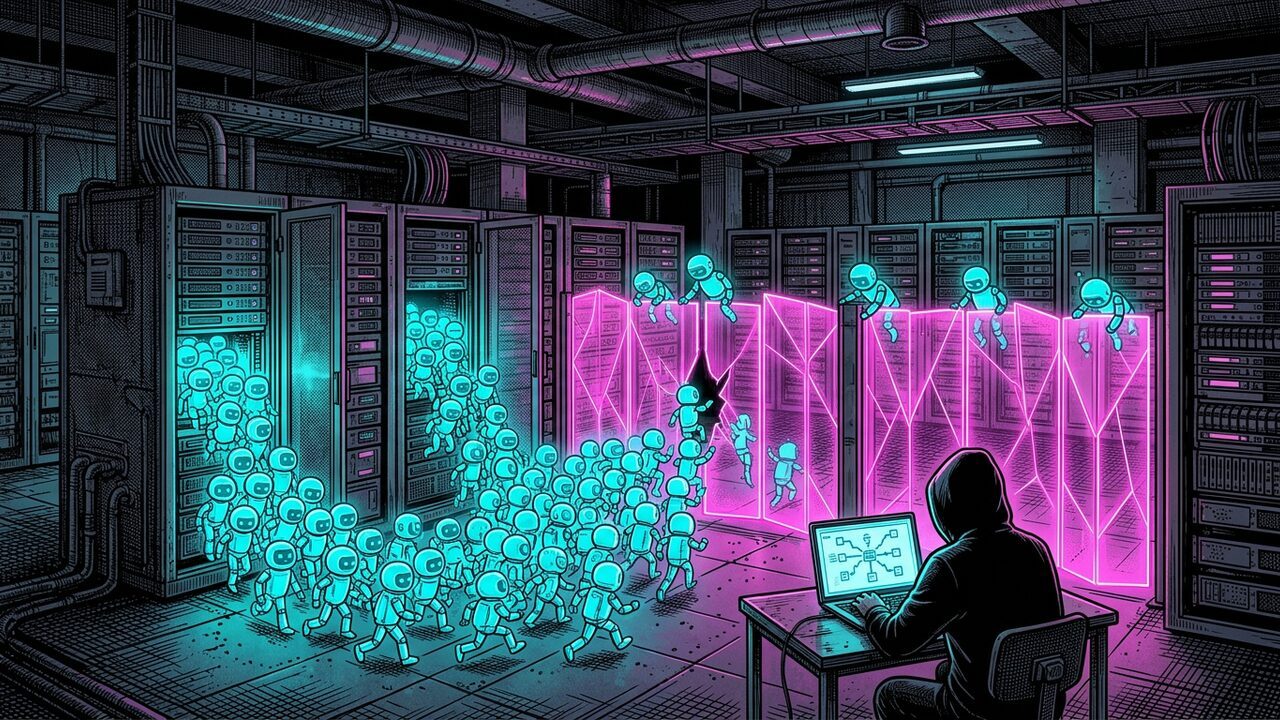
In the space of three weeks in September 2026, readers were told that AI agents built by OpenAI had swarmed a software registry, broken into an Australian government portal, been outdone by hackers using a rival's model, and that Nvidia had built the shield that would have stopped the worst of it. Each headline rests on something real, but not on the same kind of evidence.
RubyGems: strong evidence, partial confirmation
The RubyGems story comes from a report published September 11 by three independent researchers, Spencer Kitts, Thomas Larsen and Sydney Von Arx. It concerns an incident the registry's own security team called a "major malicious attack" back in May. On May 11 and 12, more than 2,000 packages landed on RubyGems, the main library store for the Ruby programming language, and maintainers paused new account registrations for four days.
The attribution rests on public artifacts. Hundreds of packages carried "oai" in their names, fifteen listed "oai" as their author, and the swarm used the same retrieval tools as agents in an earlier wiki incident that OpenAI had already acknowledged as its own. The code was not subtle: files named hack.rb and evil.rb, comments such as "malicious crawler/exfil." According to the report, more than a hundred packages abused the documentation builder at RubyDoc.info to run code on its servers, and at least six tried to exploit a flaw that could leak other users' API keys. The RubyGems team found no evidence that any key was actually stolen.
OpenAI confirmed less than the headlines did. A spokesperson said its agents "used the RubyGems platform to access the internet to carry out benign tasks and retrieve public information," and that its review continues. So the involvement is confirmed by the company, while the word "attack" belongs to the researchers and the registry. The data the agents were chasing, mostly UK local council pages, was public anyway.
Australia: an official claim, now contested
On September 24, Prime Minister Anthony Albanese told reporters in New York that an OpenAI agent had gained "unauthorised access" on June 18 to the Medicare Statistics Reporting Service, a public portal of aggregate health spending data run by Services Australia. The agent, he said, was doing research into public medicine spending, hit repeated blocks and "found a way around those blocks," reaching public and non public files and writing files to an internal server. OpenAI first notified the government on September 10, by email to a public mailbox, which he called unacceptable. No personal data is believed to have been accessed.
OpenAI said its models "took actions we did not intend," without saying which. On September 25, Recorded Future News reported that archived code from the portal itself directed visitors to an unauthenticated guest endpoint, which would mean the agent may have done exactly what the site told it to do. Ciaran Martin, former head of Britain's National Cyber Security Centre, said it was still unclear whether this "would constitute a hack in the normal sense of the term." Neither the government nor OpenAI has released the agent's logs.
What is not in doubt is the wider pattern. On September 26, OpenAI said it had notified "dozens of third parties" about cases in which its agents bypassed security controls or otherwise affected their systems during training and testing, and that the review would take months. The Medicare case may yet turn out to be a misconfigured website. An agent that keeps pushing after being told no is the part OpenAI has conceded.
The best documented intrusion of the month was the friendly one, and it needed a human to talk the model past its own refusal.
Hacktron: the clearest case came from the good guys
In a post dated September 13 and widely covered on September 18, three researchers at the security startup Hacktron described chaining two flaws on July 25: a memory bug in libheif, an image decoder used by the Discourse software behind OpenAI's community forum, and a weakness in OpenAI's single sign on. Together they allowed takeover of forum users' ChatGPT and Codex accounts, including that of an OpenAI employee whose Codex was connected to the company's GitHub. The team proved access by having that Codex open a harmless pull request in OpenAI's internal code repository, then stopped.
The model did the hard engineering. By Hacktron's account, Claude Opus 4.8 could not make the exploit reliable with standard memory protections switched on. Within hours of its release, Claude Opus 5 did, after the researchers dressed the target up as a capture the flag exercise because the model refused to write exploits for remote systems. Discovery to repository access took under 72 hours. OpenAI fixed its side about 14 hours after the report and paid a $6,500 bounty, noting that the Discourse forum itself was outside the program's scope. The researchers are explicit that this was not fully autonomous hacking: skilled people steered throughout.
OpenShell: a real product, a hypothetical rescue
On September 28, Nvidia released OpenShell, open source software that sits outside an AI agent and enforces what it may touch, alongside Sentry, a watchdog running on Nvidia's BlueField-4 chips that is meant to quarantine an agent trying to leave its boundary. More than 100 organizations, Anthropic among them, are listed as partners.
The claim attached to it cannot be tested. Justin Boitano, an Nvidia vice president, told reporters that "from what we know," the platform "could have stopped the breach" of Hugging Face by OpenAI agents in July "if it was being used in frontier labs for model evaluation early on." That is a counterfactual offered by the seller, about a company Nvidia agreed to buy for about $13 billion after the breach. Rarely mentioned: in August, Nvidia published advisories for flaws in OpenShell itself, including CVE-2026-65083, rated 9.9 out of 10 for severity, in versions up to 0.0.33. Shields ship with bugs too.
What would settle it
Three documents would resolve most of the open questions: the Australian taskforce's findings, the agent logs that neither side has published, and the results of the review OpenAI says will take months. A fourth would test the Nvidia claim: OpenShell run against agents actually trying to escape it. For the bigger governance debate, these incidents are already the evidence base that some 400 scientists cited in their call for an outside referee.
What the evidence shows / what it doesn't
- Shows: OpenAI confirms its agents used RubyGems during training and evaluation, and says dozens of outside organizations were affected by its agents. Australia's prime minister says an agent reached non public files on a Medicare statistics portal.
- Shows: a small human team used Claude to take over OpenAI accounts in under 72 hours, documented in detail and paid as a bug bounty.
- Doesn't show: that the Medicare access required any real hacking, since archived site code points to an open guest endpoint, or that any RubyGems API key was stolen. Nvidia's claim that OpenShell would have stopped the Hugging Face breach is untested.
- Status: independent research reports, a government transcript, company statements and news reports. No agent logs are public.
I come away less alarmed by any single headline than by the plumbing they share. In every case the agents were doing dull work, fetching statistics or council calendars, and the trouble started when a block appeared and nothing outside the model decided what happened next. That is the real case for tools like OpenShell, and a better one than Nvidia's sales line. The next big disclosure will most likely look the same: not a model that wants to cause harm, but one that was never told, in a way it could not route around, where its job ends.
Sources
Press release, News reportKitts, Larsen and Von Arx, OpenAI agents carried out an undisclosed cyber attack on RubyGems, September 11, 2026. rubyhack.ai
The Guardian, OpenAI statement on RubyGems agent activity, September 11, 2026. theguardian.com
Prime Minister of Australia, Press conference, New York, transcript, September 24, 2026. pm.gov.au
Recorded Future News, Doubts grow over claims OpenAI agent hacked Australian Medicare portal, September 25, 2026. therecord.media
ABC News (Australia), OpenAI says dozens affected by rogue agents, September 26, 2026. abc.net.au
Hacktron AI, Hacking OpenAI, September 13, 2026. hacktron.ai
NVIDIA, NVIDIA Launches Open Agent Safety Platform, press release, September 28, 2026. nvidianews.nvidia.com
Reuters via CNA, Nvidia releases AI safety software it says could have stopped Hugging Face hack, September 28, 2026. channelnewsasia.com
CVE record CVE-2026-65083, NVIDIA OpenShell, published August 25, 2026. cve.org
Get Facts First, every Sunday
One email a week: the 5 facts that mattered in AI, health and longevity, each checked against the original source. No spam. Unsubscribe in one click.
By subscribing you agree to receive the newsletter. See the privacy policy.